Monday, May 10, 2010

Stunning Sasa!

My mom and I took a morning walk to the Eldan office in Jerusalem, rented another car with much more waiting and disorganization, and then I thought we'd have no problem getting out of Jerusalem.  Wrong.  There is a conspiracy in that city against drivers who don't love one-way ("chad-sitri") streets!  Perhaps this somehow links into Jerusalem syndrome (for more on this phenomenon see http://en.wikipedia.org/wiki/Jerusalem_syndrome), but I think I just managed to exit the city without going insane.

Our next stop was Bet Shean, where there were incredible ruins of an old city that was big in Greek/Roman/Byzantine eras.  Just before getting there, I guess because we were near a Jordan border crossing, we passed a checkpoint.  Up until now, at every checkpoint we have just been waved on through, but this time the officer asked for our passports and after looking through mine she told me to drive to the inspection station.  So I drove over there and after no immediate response on my part to "Mah ha-inyanim?" (which is like Israeli slang for " 'S up?" and I hadn't been able to figure out what the right response should be to that -- I know now it's "b'seder" -- which is probably the most commonly spoken Hebrew phrase) -- the officer asked me to get out of the car.  He then proceeded to question me about why was I in Israel, where was I coming from, who did I stay with in Jerusalem, hmmm my last name sounds like a Jewish name and is it?  Why then do I say I have only friends and not any family in Israel?  The response I came up with -- I'm sorry, but everyone in my family who did not make it to the US was killed 60-70 years ago -- finally satisfied him.  They didn't question my mom at all.  And very surprisingly to me, after all that they did not want to inspect the trunk and the massive luggage in it.  I figure it must be because they had some advance intelligence on how heavy the luggage was and how it contained dirty laundry ;-)  My mom later speculated they must have stopped me because of the interesting-to-Israelis stamps in my passport from visits to Muslim countries like Malaysia and Indonesia that Israelis are not allowed into.  My later host, Dyanne, told me they must have had some sort of intelligence info that there was some kind of incident that day and to look for some specific kind of person.  Still, I doubt it was a redhead in a rental car who could speak some of the language travelling with her mom.  But anyway, after all that they gave us directions how to get to the tourism oriented antiquities site of Bet She'an.


For more on that very interesting site, see http://en.wikipedia.org/wiki/Bet_Shean, and my pictures which will follow at some point.  It was really a whole city, again on the scale of Ephesus in Turkey and very impressive.  Pretty much under any piece of ground in Israel is some sort of deep ancient history.  Unfortunately it was very hot and my mom was tired, so she didn't feel like walking around crumbling stones (which to her is what archaelogy equals) so I did it on my own and tried to come back before she melted.  We also stopped at a supermarket in Bet She'an and got a great picnic lunch of baba ghannouj and hot baked pita bread.

Next stop: Kibbutz Sasa.  Partway there from Bet She'an, the surroundings started to become stunningly beautiful, green and lush.  This is deep in the Galilee and close to the northern border with Lebanon.  We were there to visit Gideon and Rina, our CS hosts.  This kibbutz was started one year after the founding of the state of Israel (1949) by some very inspired pioneers from the US and Canada, including Gideon who was there when it was a start-up and was one of the founding members!  They were a lovely couple, and at age 83 he is the oldest CS host in Israel.  They were featured in a newspaper article about Couchsurfing that appeared in "Yediot Achronot" (a major Israeli newspaper) in 2007, which was actually how many of my other hosts were inspired to join!  So it was cool to read that article which they had a copy of, and also to hear about the starting-out days of the kibbutz which was rough.  Interestingly, my mom remembered that her grandfather had had a farm in New Jersey in the 1940s-1950s and that there were some young people that were part of the kibbutz movement who lived down the road and were training for a year before making their way to the grand adventure of Israel in those days -- and their house burned down and my great-grandfather was one of the farmers that allowed them to set up tents and camp on his land in the late '40s.  Gideon said that some of these people were the same ones who helped found Sasa!  So, a delightful piece of history coming full circle.


Sasa is now a very successful, wealthy kibbutz which has a plastics factory which manufactures vehicle armor.  While they are more famous for this, they also produce broiler chickens and have a beef herd, and grow kiwi, apple, avocado and grapefruit.  Everyone who lives there has a nice amount of space and seems to be into cultivating flowering plants as a hobby, therefore it was a beautiful, colorful place.  I particularly enjoyed hearing the history from Gideon, and hearing Rina's news -- she just got granted her PhD at age 70 in linguistics, which she's been working on for 6 years!  Proof that one can probably accomplish anything one sets one's mind to, and a good excuse for celebrating :)  That evening we got to go with them to a sort of happy-hour with drinks and desserts at the Moadon, which is like the kibbutz' clubhouse.  Very fun.


The following morning, we set out to see Bar'Am, the ruins of perhaps one of the oldest synagagoues in Israel (there's a lot of competition for that title).


After that, we decided to go to the Hula Valley Nature Reserve -- and drove along Highway 899, which after having "done" Israel I can now say is my very favorite road in Israel for its amazingly spectacular stunning views.  Every two minutes I wanted to stop driving and take photos and sadly I could not, so you guys will just have to go there!  The area is hilly with twisty/windy but good roads, and when you're up at higher elevation you can see the agricultural fields and other landscapes unfold below...

Hula Valley is pretty damn cool too!  It was a swamp which the land of Israel was going to completely drain out in the early '50s and then at the last moment the conservationists convinced them to set aside a chunk of land for a nature reserve, as this is one of the major spots of the migration of birds along the Syrian-African Rift when each year they commute between Europe and Africa.  For more, see http://en.wikipedia.org/wiki/Hula_Valley.  The huge migration in spring tends to end by late March, and during that time you can literally see thousands of birds darkening the sky above all at once, and I'd like to go back there during that time ... but for now we had to settle for an amazingly sophisticated multimedia presentation including a 3D movie in English with special glasses AND special effects called "Frequent Fliers" -- that and seeing the reserve itself and hiking a little trail.  We did get to see a fair number of water birds, including a hide constructed over the water where you can sit and observe them without them noticing you.  Of course it was nothing like the mass migration but still plenty to hold the attention and of course less tourists mobbing the place than I'm sure there are in March.  We also saw lots of turtles, huge African catfish, and frogs.  Missed the water buffalo. Next time!


After viewing wildlife I'm always hungry ;-)  So we next went for an incredibly decadent and delicious lunch at Ein Camonim, a goat-cheese dairy where they have these lunches where you can't order anything specific -- they just bring you an enormous cheese board with a slice of at least 12-15 different types of cheeses, soft, hard, goat, non-goat, Israeli, non-Israeli, you name it!  plus wine, plus all those little yummy salads you find in Israel, plus breads, plus coffee/tea/dessert.   Apparently they will bring you as much as you want till you are satiated, but we were satiated after the standard serving size which was quite generous.  It was a beautiful setting, very elegant, reminded me of the good things about Napa Valley ... yum!!   Check them out at http://www.ein-camonim.co.il/cheese.html or a review at http://www.frommers.com/destinations/safed/D59742.html.


After that it was all we could manage to go later to a nice party at the kibbutz for all the people over a certain age celebrating birthdays in March through May.  This featured ... cheese platters!  Groan!  I did however manage to have some truly delicious borscht, and Italian frizzante.  What a vibrant group of older people many of whom were in the founding generation of the kibbutz.  Though they are mostly from English speaking backgrounds, they seem to have a mutual agreement to use Hebrew as the spoken language.

We had a great time with Gideon and Rina, and were sad to say goodbye to move on to Tzfat and Tiberias ...


Thursday, May 6, 2010

Jerusalem of Gold, Part 2


Our next adventures in Jerusalem the following day included a visit to Hadassah Hospital and a trip to Yad VaShem, the impressive Holocaust memorial.

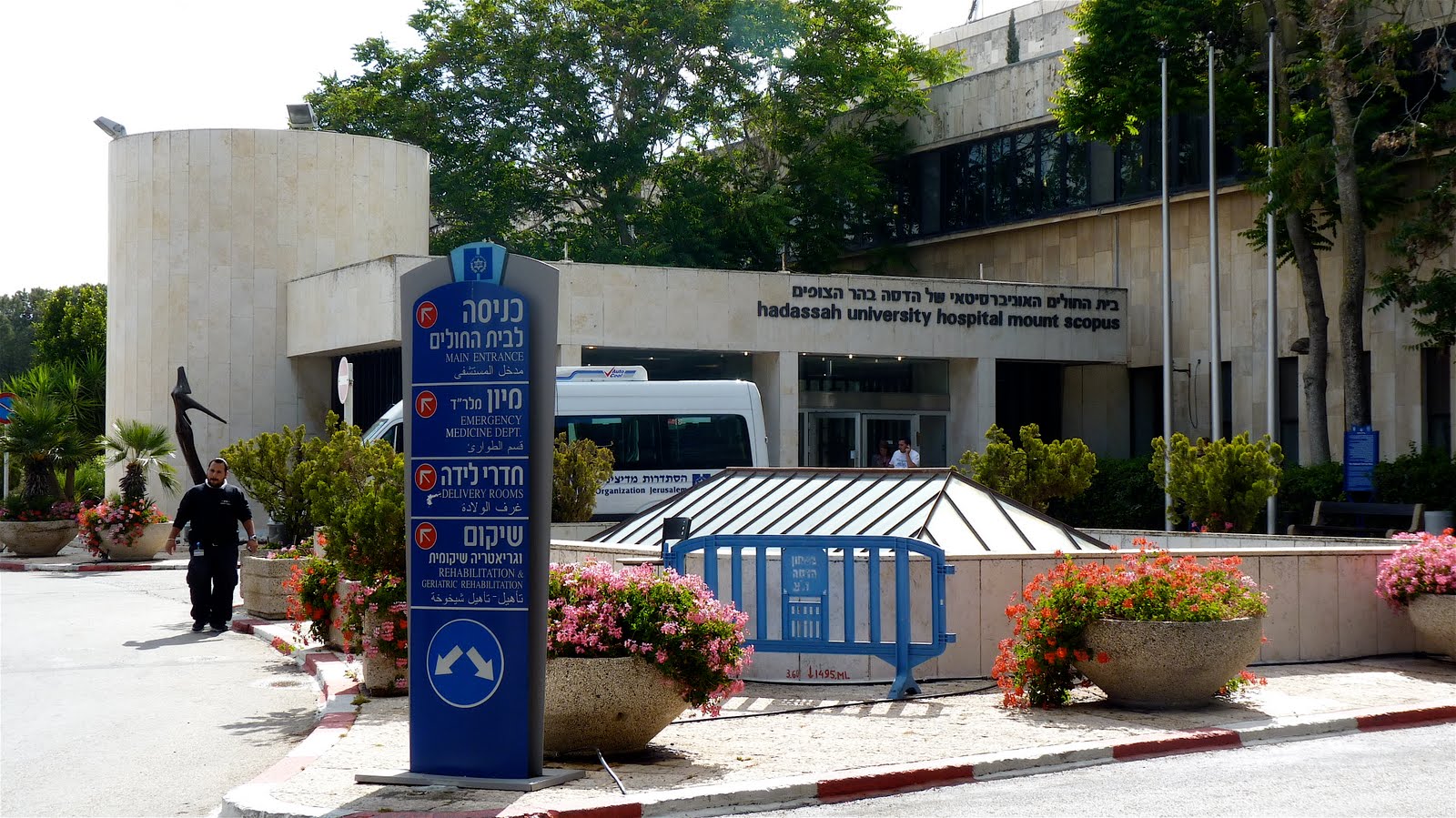
I had set up the Hadassah visit and private tour weeks in advance, as I knew my mom would want to see the place she had done fundraising for for decades.  She also really wanted to see the famous Marc Chagall stained glass windows that adorn the Hadassah Hospital.  Well, we started out on the bus bound for Hadassah.  Only, I forgot to ask the bus driver WHICH Hadassah.  How was I to know that the #19 bus goes both to the massive Hadassah-Ein Karem campus and also the Hadassah-Mt. Scopus campus in the Arab eastern part of Jerusalem?  Well, we wound up at the second one.


As soon as I got off the bus I thought nice hospital campus, but somehow it just doesn't seem as huge as I was expecting ... and then I realized we were at the wrong place.  We ended up getting back on the #19 going to the complete opposite end of the route and so as a result were of course late for our tour, but I was able to call the lady and explain what happened and she was totally cool about it.  I will now have sympathy for patients' family members who show up an hour late and say "Oh, but I thought she was at the OTHER John Muir..."

For some of the history of both campuses, see http://en.wikipedia.org/wiki/Hadassah_Medical_Center.

Our tour guide Annette was an American expat who's lived in Israel for about 40 years.  She is very proud of the amazing work that Hadassah does.  They really are very ahead of us in a lot of ways such as compassion, stuff provided to patients and families, and awareness of possible upcoming disasters/mass casualties/biological warfare because these issues are so real in Israel.  Another thing that most people probably do not realize is that well over half the care is provided to Arab patients (and on the Mt. Scopus campus, 80%).  First she took us on a tour of the pediatrics area, including pediatric oncology and long term stays.  The place is decorated in a very nonforboding way,


and a place is provided for the parent to stay with the patient (it is expected that they will) and the patients are matched up by parents having the same language in common so they can support each other.  Food is provided free for the patient's family also.  They have very extensive art therapy and also a very major clown program.  I got to meet and talk with one of the clowns, who was originally from France.

They started with 3 clowns and now have over 70 nationwide.  They are the key to distracting the sick kids while they get IVs and such.  They also receive dolls where everything that happens to the patient, they get to sort of reenact on the doll, such as putting in ports.  This takes away a little of their feeling of helplessness and disempowerment.... Additionally they have a school on premises with teachers in both Hebrew and Arabic so that the kids don't fall behind if they are there long term.  All staff is required to be bilingual in Hebrew and Arabic (and English doesn't hurt either, apparently).  Hadassah boasts an 82% cure rate for childhood cancers.  I don't know what the US cure rate is, but I can't imagine it's higher.  

Part of what makes things easier is, of course, that everyone in Israel has health insurance coverage guaranteed to them by the state, unlike the US.  They all belong to one of 4 different Kupat Cholim organizations (like HMOs) and are allowed to change primary MDs and/or health plans every 3 months if they want.  So if someone needs some complicated treatment there aren't massive problems with compliance issues.  And there is no one clogging up the ER due to homelessness, very very few due to drug-seeking behavior, and less for problems that could have been solved as an outpatient.  A pleasure!  I found this out during my tour of the ER where I got to talk with one of the ER doctors who was trained in internal medicine in New York and moved to Israel about 6-8 years ago.  She agreed that there was vastly less ridiculousness to make her job unpleasant -- but she did complain about the salary, which I had no polite way to try to quantify.  What else --they staff very generously so everyone gets seen quickly, workups happen quickly, and no one is super grumpy.  The ER is full of posters about biological warfare and they have regular practice regarding major trauma/terrorism events.  They can very quickly double the bed capacity with equipment that comes out of the ceiling in the waiting area and other things that magically unfold.  The last major thing that happened was a wedding with 250 people where I guess the floor of the building collapsed and they suddenly had all these people rushed in.  That must have been very very vigorous dancing of the hora!

Hadassah has a 700 bed capacity but is already in the middle of constructing a massive new 14 story tower to be finished in 2012 that will supply another 500 beds.  There will be a healing garden on every other floor "because people do better when nature is emphasized" ... and 4 floors that are completely underground including the OR, the doctors' offices, and medical records -- this is in case of war and bombings.  Sad that this kind of thing always has to be taken into account, but that's the reality sometimes of life in this country.  Also sad is that because of this construction, those Marc Chagall stained glass windows in the synagogue have been covered up to protect them!  So we'll have to come back.  We'll add one more thing to the long list of things we missed in Jerusalem, which also includes seeing the underground excavation area with the tunnels under the Old City...

From there we went to Yad VaShem (http://en.wikipedia.org/wiki/Yad_Vashem), the massive Holocaust memorial and museum.  It was really done on a grand scale, which of course helps mirror the hugeness of the atrocities committed.  We spent 3 hours just looking at the exhibits of the major museum.  I was especially captivated by the audiovisual histories of different survivors that were playing (mostly in Hebrew with English subtitles as these are people who had found refuge in Israel after the Holocaust).  We then realized we had finished so late that we missed the accessory museums including artwork by Holocaust survivors, and the outdoor garden area, and a few other things.


That evening we went for Ethiopian food which I thought would be interesting since there is such a sizeable community of Ethiopian immigrants.  The restaurant wasn't that fabulous, but I did enjoy talking to the proprietor in Hebrew about the difference between the injera from Oakland to Jerusalem (he claims more authentic teff comes to Israel from Ethiopia, which is really just a few hours away by plane).

The following day we decided we had not yet overdosed on museums, so we went to the Israel Museum (http://en.wikipedia.org/wiki/Israel_Museum)-- but hadn't realized it is undergoing a massive renovation and will probably be reopening later this year.  It's the largest museum in Israel, but all the art and stuff was off limits.  We were relegated to the Dead Sea Scrolls, housed in an interesting building called the Shrine of the Book which resembles a white Hershey kiss but is actually supposed to simulate what the earthenware pots looked like in which the first 7 scrolls were found. 


I had a nice hour long tour of this exhibit, which was about this weird cultish group called the Essenes who had moved away from Jerusalem in the 2nd century or so, were into ascetism and communal living in the Dead Sea area (somewhere away from Sodom and Gomorrah, I'll have to assume), and wrote these scrolls found at Qumran.  There was also an interesting exhibit on the Song of the Sea (the celebratory song that was sung in the Bible when the Egyptians drowned in the Red Sea) and different audiotaped renditions of it depending on the different cultural origins of the singers.  The other thing that was very interesting (and not off limits) was a reconstruction on a 1:50 scale of Jerusalem during the 2nd Temple Period.


From there we went to another interesting but smaller museum called Ticho House (http://www.english.imjnet.org.il/HTMLs/Ticho_House3.aspx?c0=13392&bsp=12940), an old restored house owned by an opthalmologist and his artist wife, which had art by his wife, his Menorah collection, period furniture and also a modern jewelry exhibit by 4 female artists.  In addition to that, it houses a really lovely restaurant called "Little Jerusalem" where we had a delicious meal.


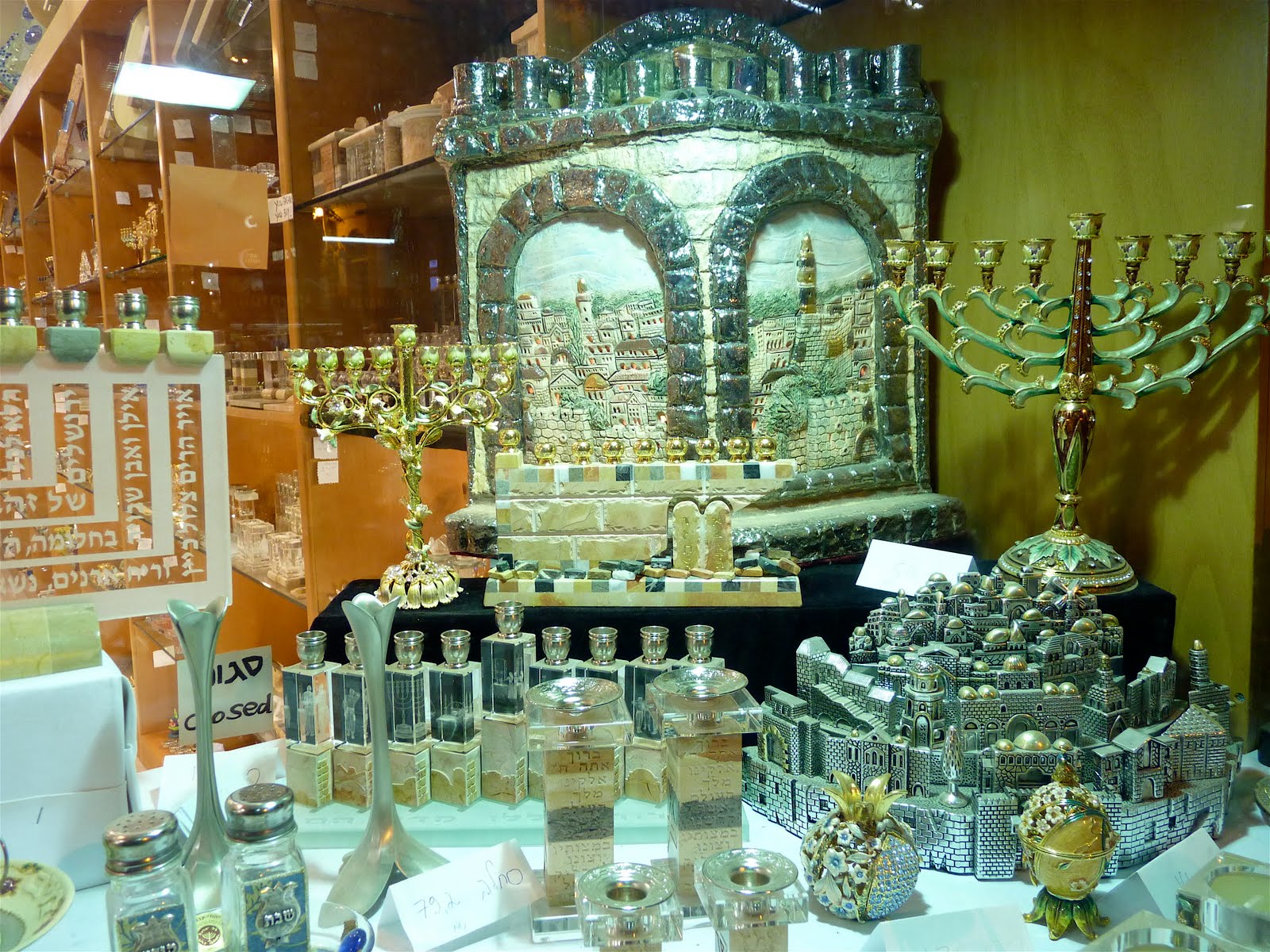
We finished the evening by walking through Ben-Yehudah Street again, the pedestrian mall that was this time beyond full to capacity due to a free concert going on at the end of it.  It turned out my mom was better at pushing through the mosh pit than I was!  Apparently they've been organizing these concerts lately to better serve the "secular" (non-religious) community of young people, which is cool.  This street has tons of all types of stores, but especially features religious paraphernalia (cool stuff like stunning art mezuzot, and less cool stuff like kippot embroidered with the name of one's favorite football team) and somehow we didn't manage to get out of there without buying a few items :)


The next morning we were on our way to the Galilee in the north and Kibbutz Sasa, but not before I got lost getting out of Jerusalem by car (however nowhere near as badly as getting in -- it only involved one or two complete circles around the old city... ;-)

More soon.